

If your upper front teeth sit well over your lower teeth, you may be wondering how to fix an overbite without fixed brackets and wires. For many adults, Invisalign clear aligners are one way a dentist may treat a dental overbite, depending on what is causing it.
At Finesse Dental, we have been caring for patients for years, and we take the time to explain your bite and your options before any treatment begins.
Quick Overview
- An overbite is when the upper front teeth overlap the lower front teeth more than usual, and it can come from the teeth, the jaws or both.
- Mild to moderate overbites that come mainly from tooth position may often be treated with clear aligners such as Invisalign, though not every bite suits them.
- Correcting a deep bite may help reduce strain on the teeth, gums and jaw, but how much it helps varies from person to person.
- The severity of your overbite, your age and whether the jaw bones are involved all shape which treatment options make sense.
- A dental assessment is usually what guides the next step and the treatment plan.
Below, we explain what causes an overbite, how Invisalign may help fix an overbite, and what to expect before, during and after treatment.
How Do You Fix an Overbite?
An overbite is usually corrected by moving the teeth, guiding jaw growth in children, or, in severe skeletal cases, repositioning the jaw with surgery. For many adults with a mild to moderate dental overbite, Invisalign is one option. The right approach depends on what is causing your overbite and how severe it is.
Dental Overbite or Skeletal Overbite?
A dental overbite comes from the position of the teeth. The upper front teeth may tip forward, or the lower front teeth may sit too high or too far back. A skeletal overbite comes from the jaws themselves, often when the lower jaw is smaller or set further back than the upper jaw. Dentists call this pattern a Class II malocclusion.
Some people have both, and the difference matters because aligners move teeth, not jaw bones. You may also hear the term overjet, or horizontal overbite. This is how far the top teeth stick out in front of the bottom teeth, often described as buck teeth.
How Invisalign Treats an Overbite 

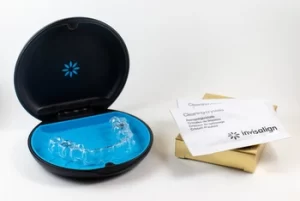
Invisalign uses a series of clear plastic trays, each made to move your teeth a small amount. Small tooth-coloured bumps called attachments may be bonded to some teeth to help the trays grip and guide each movement.
For a deep bite, the plan often aims to lower the front teeth and level the bite. Some aligners include small bite ramps, and elastics are sometimes added to help the upper and lower jaws meet more evenly.
The trays are removable, so you take them out to eat, brush and floss. They need to be worn for most of the day and night, and extra trays (called refinements) are often needed to finish a deep bite.
Other Overbite Treatment Options
Invisalign is not right for every bite. Depending on your situation, other orthodontic treatment options may include:
- Traditional braces: metal braces or ceramic braces with brackets and wires, which some people use for more complex tooth movements.
- Lingual braces: braces fixed to the back surfaces of the teeth.
- Growth-guiding appliances for children: these may help guide the upper and lower jaws while a child is still growing, which is why early intervention is often discussed.
- Corrective jaw surgery: in severe cases of skeletal overbite, orthognathic surgery combined with orthodontic treatment may be recommended, which involves a referral to an oral and maxillofacial surgeon.
What Problems Can an Untreated Overbite Cause?
A slight overlap is normal, and minor overbites often cause no problems at all. A significant overbite, though, may affect your teeth, gums and jaw over time.
- Tooth wear: when teeth meet unevenly, excessive wear can make them sensitive or prone to chipping.
- Gum problems: in a very deep bite, the lower front teeth can bite into the gum behind the upper teeth, which may cause irritation or gum recession. Our gum disease treatment can help when the gums are already affected.
- Jaw pain: an uneven bite may put extra load on the jaw muscles and the temporomandibular joint (TMJ). Some people notice chronic jaw pain, clicking or headaches, and TMJ pain treatments may help manage these symptoms.
- Eating and speaking: some people find it harder to chew food properly, and a few notice speech difficulties.
- Injury to the front teeth: upper teeth that stick out are more exposed during falls and sport.
What Affects Overbite Correction?
- Genetics and jaw size: the size and shape of the upper and lower jaws often run in families.
- Childhood habits: thumb sucking, long-term dummy use and tongue thrusting can push the upper front teeth forward while the jaws are developing.
- Crowded teeth or missing teeth: a lack of space, or gaps where lower teeth are missing, can let other teeth drift and deepen the bite.
- Grinding and worn teeth: worn back teeth can let the bite close down over time. If you clench or grind, tooth grinding treatment may form part of your plan.
- Age: children’s jaws are still growing, which opens options adults no longer have. Adults can still have treatment, though skeletal changes are hard to influence without surgery.
- Aligner wear: trays only move teeth while they are in your mouth.
How to Care for Your Teeth During and After Overbite Treatment
Good habits protect your teeth and gums while they move and help keep your corrected bite stable.
- Wear your trays as directed and remove them to eat or drink anything other than water.
- Brush and floss before putting your trays back in, so food is not trapped against your teeth.
- Keep up regular check-ups and cleans, as poor oral hygiene during treatment can lead to tooth decay, discolouration and other risks linked to braces and aligners.
- Wear your retainer after treatment. Teeth tend to drift back, so removable retainers or a fixed wire are usually recommended to hold the new position.
A Considered Approach to Overbite Correction
 Every bite is different. The right overbite treatment depends on your teeth, your jaws, your age and what you would like to achieve, and individual outcomes vary. A comprehensive dental examination, often with X-rays and a 3D digital scan, helps show whether your overbite comes from the teeth, the jaws or both.
If you would like to find out whether Invisalign may suit your bite, our team at Finesse Dental can check your bite, explain what we find and talk you through what treatment may involve. Call us on (02) 8806 0790 to arrange a consultation at a time that suits you.
Frequently Asked Questions
Can Invisalign fix an overbite?
Invisalign may correct many mild to moderate overbites, especially when the problem comes from tooth position. A skeletal overbite caused by the jaw bones may need a different approach, so an assessment is the first step.
How long does it take to correct an overbite with Invisalign?
Treatment time depends on the severity of your overbite and how your teeth respond, and deep bites often need extra trays at the end. Your dentist can give you an estimate once your teeth have been assessed.
Can you fix an overbite without braces?
Yes, in many cases. Clear aligners such as Invisalign use removable plastic trays instead of brackets and wires. Severe skeletal overbites may still need other treatment, including corrective jaw surgery in some adults.
Is it too late to fix an overbite as an adult?
No. Teeth can move at any age, so many adults have overbite correction with aligners. Jaw growth can no longer be guided in adults, so a severe skeletal overbite may need surgery combined with orthodontic treatment.
Can an overbite cause jaw pain?
An overbite may put extra strain on the jaw muscles and the temporomandibular joint, and some people with a deep bite notice jaw pain, clicking or headaches. Jaw pain can have many causes, so it is worth having your bite and jaw checked by a dental professional.
Do I need a retainer after overbite treatment?
Usually, yes. Teeth tend to drift back after treatment, so a retainer helps hold your corrected bite in place. Your dentist will advise which type suits you and how often to wear it.
References
Healthdirect Australia. Dental braces and retainers. https://healthdirect.gov.au/dental-braces-and-retainers
Effectiveness and accuracy of clear aligners in treatment of deep bite: a systematic review. Clinical Oral Investigations. https://researchconnect.buffalo.edu/en/publications/effectiveness-and-accuracy-of-clear-aligners-in-treatment-of-deep/
2025 narrative review by Lim and Meade (University of Adelaide) in Seminars in Orthodontics. https://digital.library.adelaide.edu.au/items/3f3aa0cc-8acc-465f-bf46-b2f7ea51500b