
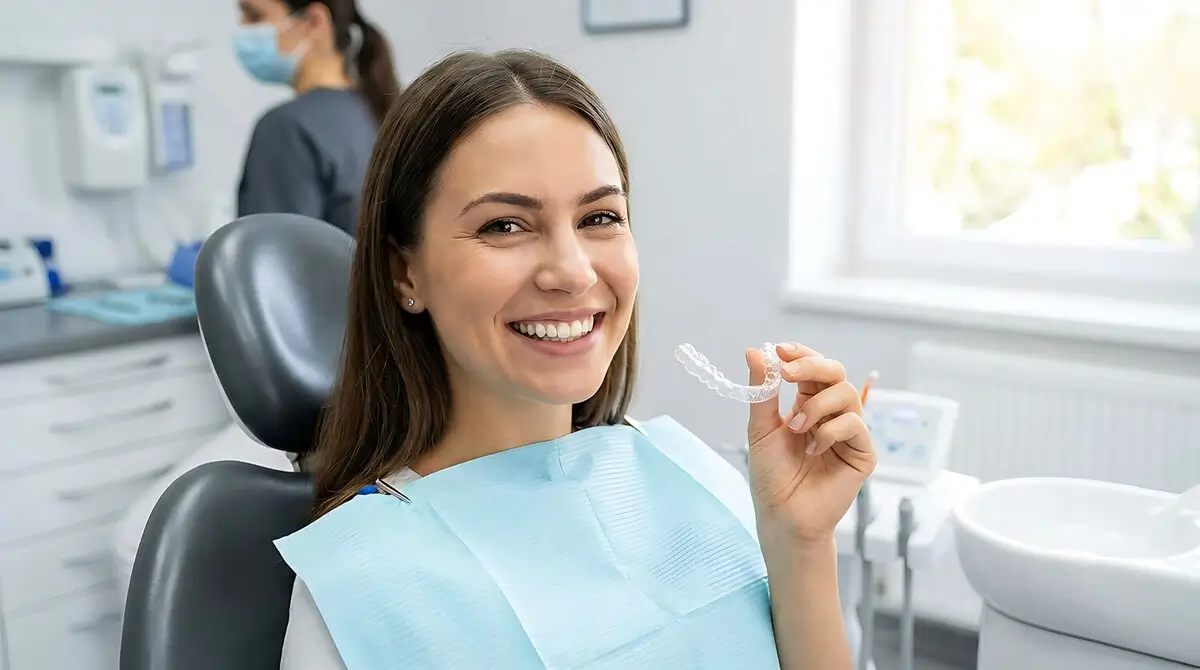
Teeth straightening has become more accessible in Australia over the past decade. Where traditional braces were once the default option, clear aligners now offer a removable, discreet alternative that suits many adults and teens with mild to moderate alignment concerns.
If you have been looking into affordable clear aligners and wondering whether they are the right fit for your teeth, the answer depends on more than cost alone. Suitability, treatment duration, and how consistently you wear the aligners all play a role in how treatment unfolds. At Finesse Dental, we offer Invisalign clear aligner treatment as part of our orthodontic services.
Quick Overview
- Clear aligners are custom-made, removable trays that gradually shift teeth into a more aligned position, typically suited to mild to moderate cases
- They may apply to adults and teens with concerns such as mild crowding, spacing, or minor misalignment; suitability varies between individuals
- Treatment involves wearing aligners for around 20 to 22 hours per day, with trays switched progressively over the course of treatment
- Treatment duration, comfort, and results are influenced by case complexity, how consistently aligners are worn, and how teeth respond to movement
- A consultation and clinical assessment are needed to confirm whether clear aligner treatment is appropriate for your situation
Keep reading to understand how affordable clear aligners work, what influences the cost, and what an assessment at Finesse Dental involves.
What Are Clear Aligners and How Do They Work?
Clear aligners are custom-made, transparent trays worn over the upper and lower arches of the teeth. They are designed to apply gradual, controlled pressure to shift teeth into a more aligned position over time. Each set of trays is worn for a period of one to two weeks before progressing to the next in the series.
 Unlike traditional braces, clear aligners have no metal brackets or wires. They are removed for eating, drinking anything other than water, and for brushing and flossing. This removable nature is one of the features that many patients find appealing about their daily routine.
An Australian clear aligner survey 2024 published in Clinical and Experimental Dental Research found that among general dentists in Australia who provided orthodontic treatment, the majority used clear aligner therapy, citing aesthetic appearance and the ease of oral hygiene maintenance as key advantages.
Clear aligner treatment is not a single brand. Invisalign is the most widely recognised system, but other options exist. At Finesse Dental, Dr Robby is an Invisalign Accredited Provider and can discuss which system may be appropriate for your case.
Are Affordable Clear Aligners as Effective as Traditional Braces?
For mild to moderate alignment concerns, clear aligner treatment can be an effective orthodontic option. This includes mild crowding, minor spacing between teeth, and small rotations. More complex bite corrections may be better managed with traditional braces.
Orthodontics Australia notes that there is no one-size-fits-all approach to teeth straightening, and that treatment decisions should be based on individual case complexity rather than a general preference for one system over another.
One distinction worth understanding: clear aligner treatment requires consistent wear. Aligners need to be worn for around 20 to 22 hours per day to work as planned. If aligners are removed for longer periods than recommended, teeth may not track properly, which can extend treatment or require additional trays.
What Affects the Cost of Clear Aligner Treatment?
The cost of clear aligner treatment in Australia varies, and several factors influence the final figure.
 Case complexity is the most significant factor. Mild alignment concerns require fewer trays and a shorter treatment period, which generally reduces cost. More involved cases need more aligners, longer treatment, and more follow-up appointments.
What is included in the quoted price matters. A transparent, all-inclusive fee should cover the initial consultation, digital scans, all aligner trays, any mid-treatment refinements, retainers, and follow-up appointments. Not all quoted prices include each of these components, so it is worth asking specifically what the fee covers before committing to treatment.
Health fund coverage may offset some of the cost. Many private health funds with orthodontic extras contribute toward clear aligner treatment, though the amount covered varies by fund and policy. Checking with your insurer before starting treatment is a practical step.
At Finesse Dental, we offer interest-free payment plan options to help make treatment more manageable over time. No credit checks are required. Our team can outline the full cost of your treatment plan at your consultation appointment.
How Is Clear Aligner Treatment Different From Traditional Braces?
Clear aligners and traditional braces both move teeth through sustained pressure, but they work differently and suit different situations.
Traditional braces use metal brackets bonded to the teeth and connected by wires. They are fixed in place and apply continuous pressure. They are often recommended for more complex alignment cases or where a fixed appliance offers more predictable control of tooth movement.
Clear aligners are removable and transparent. They cause less soft tissue irritation for many people because there are no brackets or wires contacting the inside of the mouth. Oral hygiene is simpler to maintain, as brushing and flossing can be carried out as usual after removing the trays.
A 2025 systematic review in the Dentistry Journal (MDPI) found that oral hygiene and oral health were among the most commonly cited advantages of clear aligner therapy compared to fixed appliances, largely attributed to the removable nature of the trays.
The right choice between aligners and braces depends on your teeth, your bite, your lifestyle, and what a dentist recommends after examining your case. At Finesse Dental, we take the time to go through the options with you during your consultation, so you have a clear picture of what each path involves.
Who May Be Suitable for Clear Aligner Treatment?
Clear aligners are typically considered for patients with mild to moderate misalignment. This can include:
- Mild to moderate crowding of the teeth
- Minor gaps or spacing between teeth
- Small rotations in individual teeth
- Some cases of relapse following previous orthodontic treatment
More severe misalignment, significant bite issues, or cases involving complex jaw relationships may be better suited to traditional braces or other treatment approaches. A thorough clinical assessment, including dental X-rays and a review of your oral health, is needed to confirm suitability.
Whether clear aligners are suitable depends on how much correction is needed, and a dentist can advise on the most appropriate option for your teeth.
A Considered Approach to Teeth Straightening
 Clear aligner treatment works best when it starts with a thorough assessment and a plan that reflects your individual situation. Cost, comfort, and discretion are all reasonable things to consider when looking into orthodontic treatment. So, it is about understanding what the process involves and whether you are a suitable candidate before starting.
If you would like to find out whether affordable clear aligners may be suitable for your teeth, we welcome you to contact Finesse Dental Stanhope Gardens. Our team can assess your teeth and outline what a personalised treatment plan would look like for you.
Call us on (02) 8806 0790 or book a consultation online. A complimentary initial consultation for clear aligner treatment is available. Terms and conditions apply. OPG and X-ray are not included if required; enquire at the clinic for full details.
Frequently Asked Questions
Do clear aligners affect speech?
Some people notice a slight adjustment in speech during the first few days of wearing a new set of aligners, particularly with sounds that require the tongue to contact the upper teeth. This typically settles as the mouth adapts to the trays. Most patients find that any speech changes are minor and temporary. If lisping or altered pronunciation persists beyond the first week, it is worth raising with your dentist at your next appointment.
Can I eat normally with clear aligners?
Yes. One of the practical advantages of clear aligners is that they are removed for eating and drinking. Unlike traditional braces, there are no dietary restrictions related to brackets or wires. Aligners should be removed before meals, and teeth should be cleaned before the trays are replaced to prevent food particles from being trapped against the tooth surface.
References
Meade, M.J., Foley, M., and Weir, T. (2024). ‘A Cross-Sectional Survey of the Use of Clear Aligners by General Dentists in Australia’. Clinical and Experimental Dental Research, August. Adelaide, SA: University of Adelaide. https://pmc.ncbi.nlm.nih.gov/articles/PMC11228346/
Orthodontics Australia. (2026). ‘Traditional Braces and Clear Aligners’. Orthodontics Australia, 2 April. Australia: Orthodontics Australia. https://orthodonticsaustralia.org.au/traditional-braces-and-clear-aligners/
Sonnesen, L., Kiefer, M., Kronberg, A., et al. (2025). ‘Clear Aligner Treatment: Indications, Advantages, and Adverse Effects: A Systematic Review’. Dentistry Journal, 13(1), 40, 17 January. Basel, Switzerland: MDPI. https://www.mdpi.com/2304-6767/13/1/40
Healthdirect Australia. (2025). ‘Dental braces and retainers’. Healthdirect Australia, 7 October. Sydney, NSW: Healthdirect Australia. https://www.healthdirect.gov.au/dental-braces-and-retainers